

When I rebuilt Rock of Science, one target mattered more than all the others. A collector should be able to document a mineral collection, one complete specimen at a time, in under five minutes. On their own. Without me.
That number was the whole point. Here is why.
The problem with documenting a collection
Most collectors know they should document their pieces. Species, locality, chemistry, dimensions, when and where and from whom a piece was acquired, what it cost, what it might be worth. It all matters. I have said as much in earlier pieces here, on provenance and on insurance.
Yet knowing you should do it is not the hard part. Doing it is.
Documenting a specimen by hand is slow. You look up the formula, check the hardness, the crystal system, the Strunz class, then write out the locality, the country, the acquisition details. Once, it is tedious. Three hundred times, it is a wall. So the job gets postponed, then dropped, and the collection stays a room full of beautiful, nameless strangers.
Friction is the enemy. Remove it, and the documentation actually happens. That was the target.
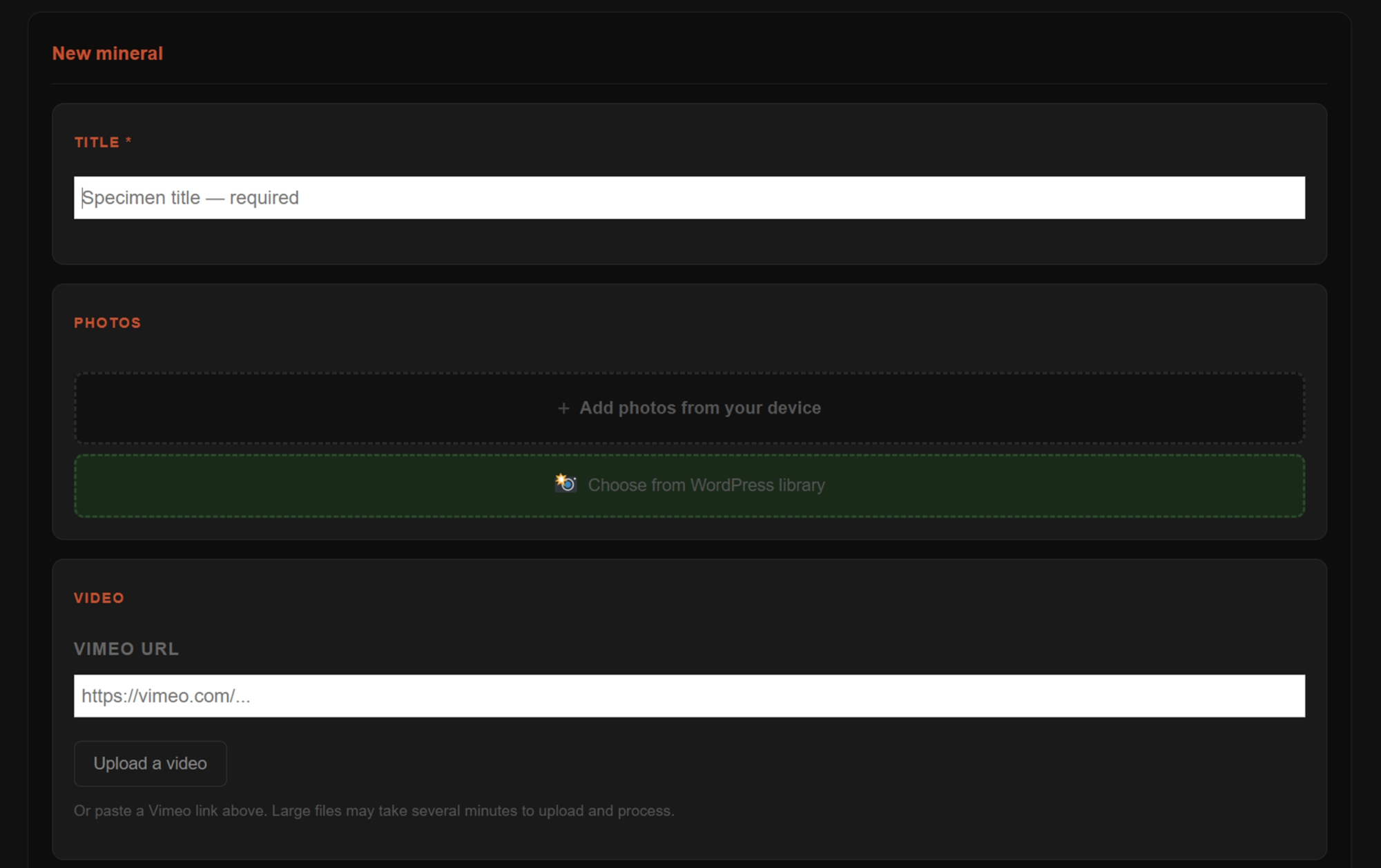
Under five minutes, everything but the photos
So I built the entry around one question. How fast can a collector record everything about a piece, alone, without looking anything up elsewhere?
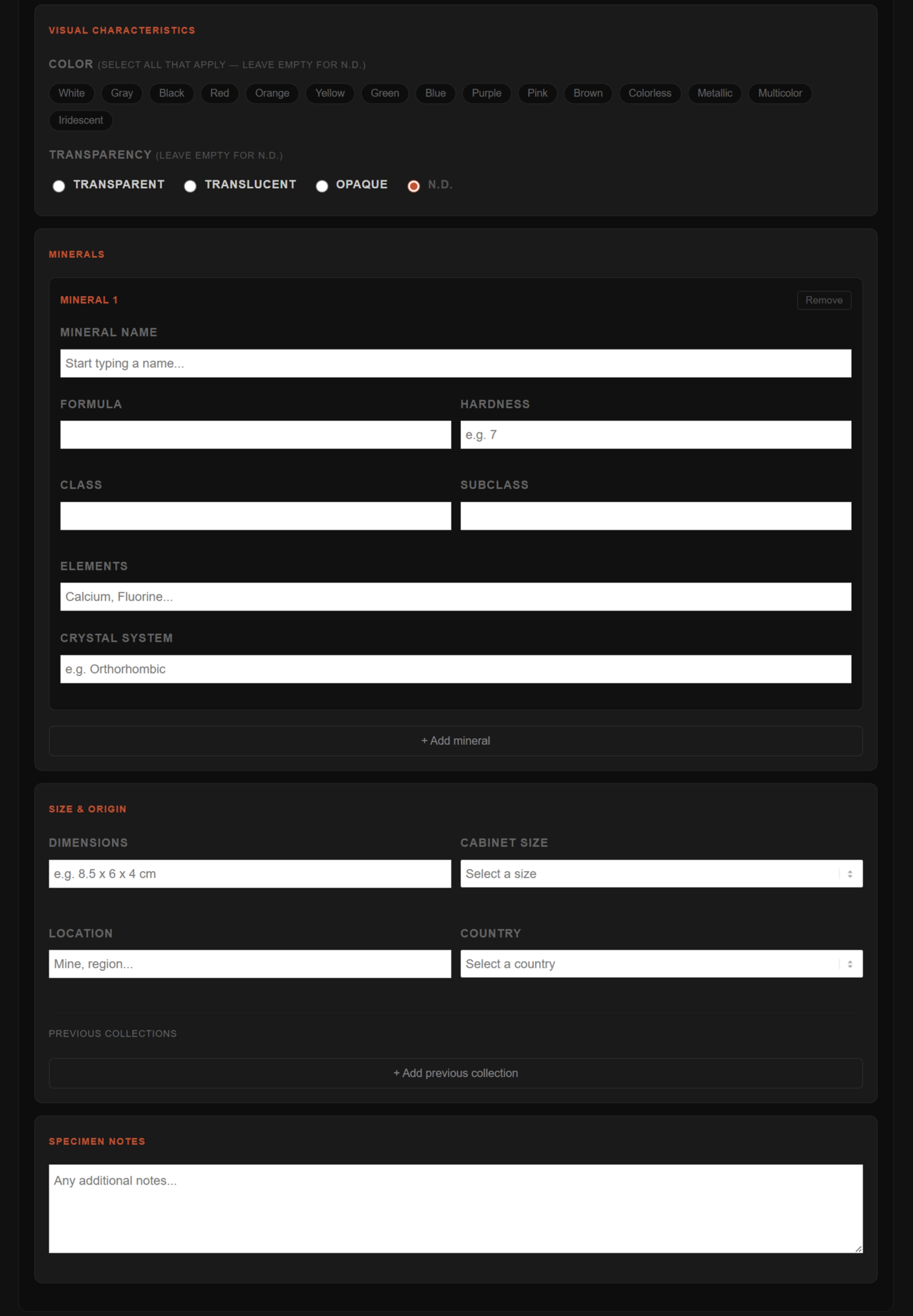
The mineralogical identity fills itself. Type the name, and the formula, the hardness, the chemical class, the crystal system and the elements all populate on their own, drawn from a database of more than six thousand IMA-recognized minerals. No formulas to hunt down. No subscripts to type by hand.
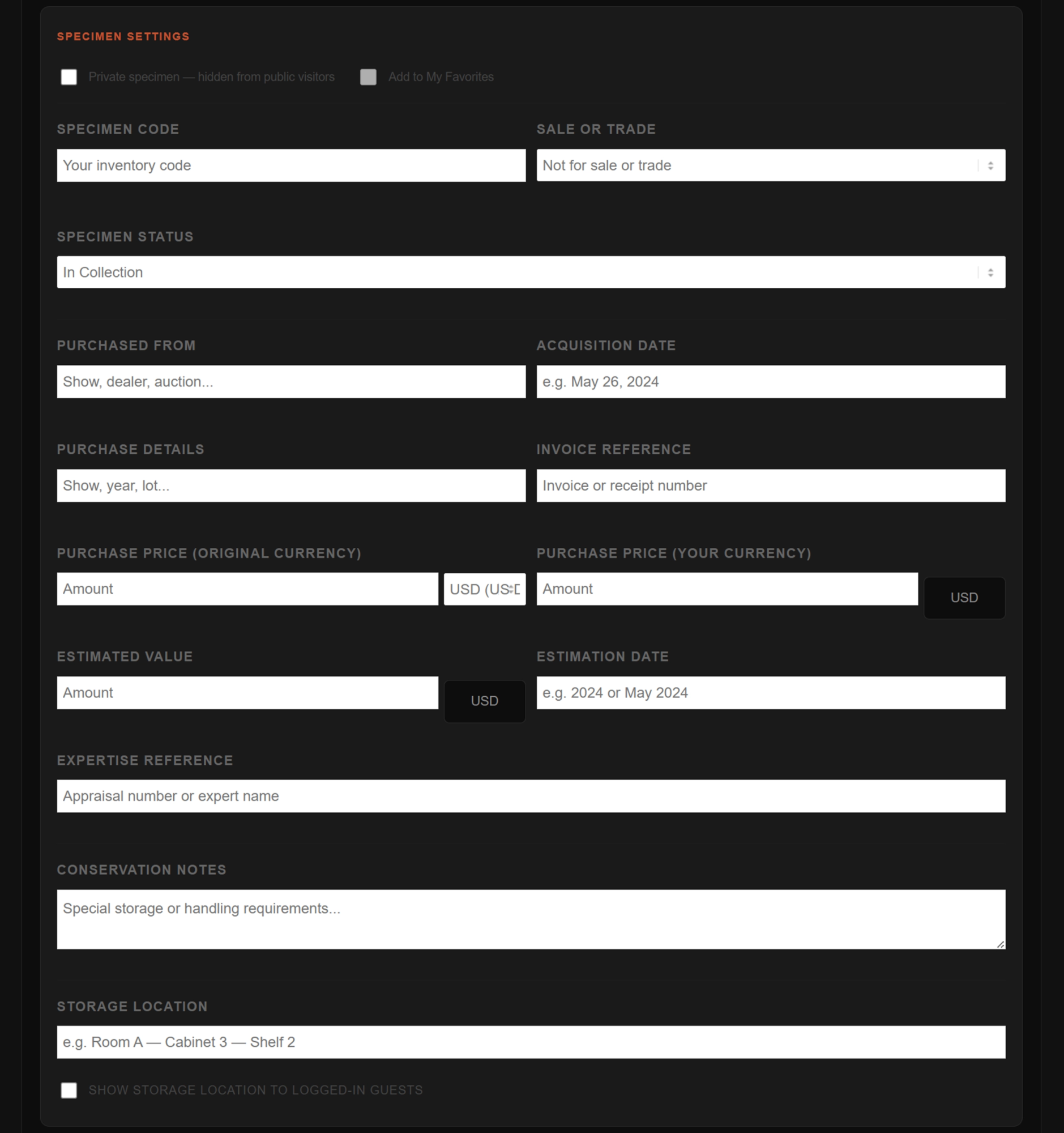
From there, the rest moves just as fast. Colour and transparency, picked from a list. Dimensions, and the cabinet category, thumbnail, miniature, small cabinet, cabinet or large, is deduced from them automatically. Locality and country. Then the layer most catalogs skip entirely: the accounting and the history. Where the piece came from, when, from whom, what was paid, in any of more than a hundred and fifty currencies. Its estimated value. Its storage location.
The status goes further than a simple label. A piece can be in the collection, on loan, sold, given as a gift, or in restoration. And when it is on loan, sold or given, the form opens the fields that follow: to whom, and when it comes back. The record tracks the specimen through its whole life, not just its arrival.
All of it, on one screen, in under five minutes. That is not a theoretical figure. I measured it myself. Entering each of the first hundred and fifty-nine specimens in the collection took about five minutes, photographs aside.
Why five minutes and not fifteen
The number matters because friction is counted in minutes, and a collector’s patience runs out fast.
At fifteen minutes a piece, documentation becomes a project. The kind you reserve a weekend for, and never quite start. But at five, it is something you do the evening a specimen arrives, while it is still in your hand and the purchase is fresh in your mind. Five minutes is the line between a collection documented as it grows and one that is forever going to be documented later.
I did not want a tool that a collector had to hand back to me. I wanted one they could run themselves, from the first day and every day after. The five-minute target was how I held myself to it. If a piece took longer, I had failed, however complete the record was at the end.
What it is really for
Speed is not the goal. Speed is what makes the goal possible.
The goal is a collection where every piece has its identity, its origin, its history, its place. Where nothing is a nameless stone because recording it felt like too much work. Where the catalog keeps pace with the collection instead of falling permanently behind.
I wrote here, not long ago, that a specimen without its label is just a rock. A collection without its records is the same thing, scaled up. Collectors do not resist the idea of documenting a mineral collection. They resist the time it takes. Bring that time down to five minutes, and the last excuse is gone.
That was the idea. It was always the idea.
 © Minerals Photography — Camarda Visual Studio LLC
 © Minerals Photography — Camarda Visual Studio LLC