

The Rock of Science platform started in 2021, with a friend and a few dozen minerals.
He is a collector. He wanted his specimens online, somewhere he could look at them, organize them, share a few with other collectors. Nothing elaborate. We built something simple, the two of us, and for what it needed to do at the time, it was enough. A few dozen specimens, each with its photographs and its basic information. It worked.
Then the collection grew.
Where the Rock of Science Platform Stands Now
By 2024, the collection had passed three hundred specimens, with a ceiling somewhere between five hundred and eight hundred in sight. And the simple website we had built was no longer simple to use. It was the opposite of simple. It had become an exercise in patience.
Adding a single specimen was a small ordeal. I would look up the chemical formula by hand. I would write the links by hand. There was no automation, no autocomplete, nothing that filled itself in. No color filter, no hardness filter, no way to browse by country or by crystal system, because none of that existed. Every piece of information was entered manually, one field at a time, and the collector could do none of it himself. Every update went through me.
We had built something that, three hundred specimens later, had less in common with a website than with a paralyzed pachyderm. It moved, technically. Slowly. With great effort. And only when pushed.
From the visitor’s side, it held up. It lacked brilliance, but it functioned. Behind the scenes, it was held together by manual labor and stubbornness.
The moment it changed
Two things happened at roughly the same time.
The collection’s growth made the old approach untenable. And other collectors started to notice. Among them, people at the Musée des Cristaux in Chamonix, who saw what we had built and asked me to contact them when it was finished, when it was something more.
That was the turning point. Until then, I had been maintaining a single website for a single collector. The question changed. What if this were not one website, but something a serious collector could actually use, whoever they were?
So I rolled up my sleeves, sharpened my keyboard, and wrote the best php and mysql I could produce. Three months later, the paralyzed pachyderm was gone. In its place: rock-of-science.org.
What it became
The difference is the difference between a flint and a fighter jet.
Where I once looked up every formula by hand, the collector now types a mineral’s name and watches the formula, the hardness, the chemical family, the crystal system, and the elements fill themselves in, drawn from a database of more than six thousand minerals recognized by the IMA. What used to take minutes of manual research takes seconds.
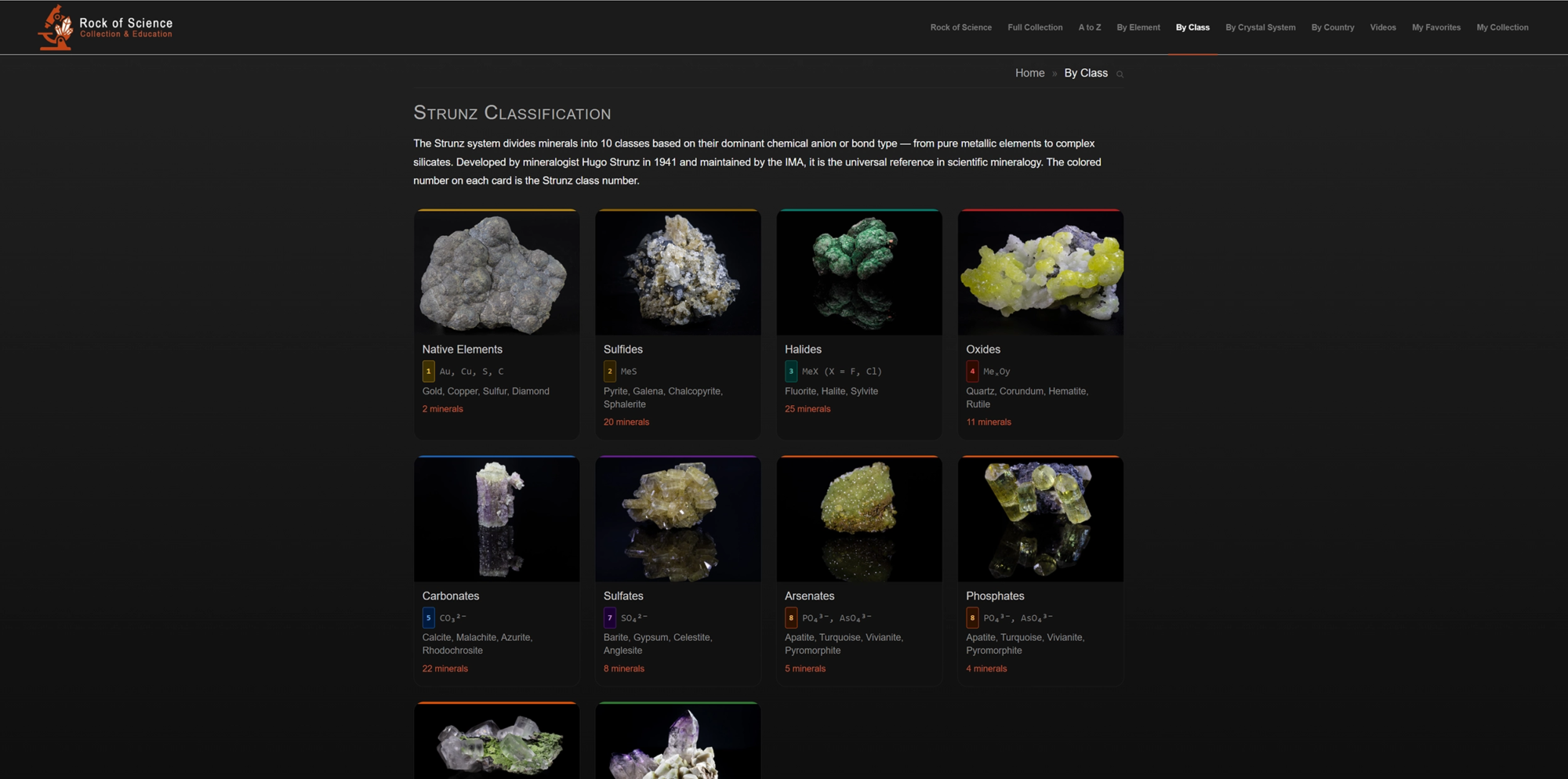
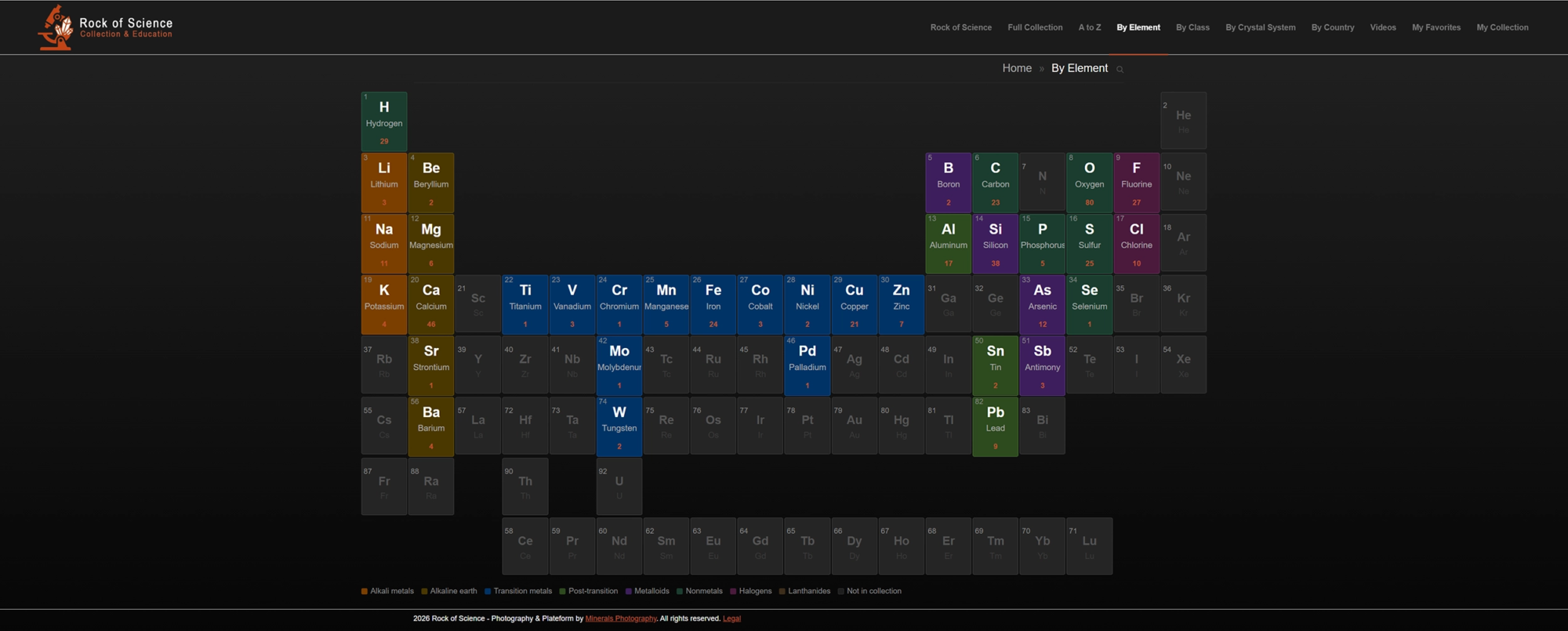
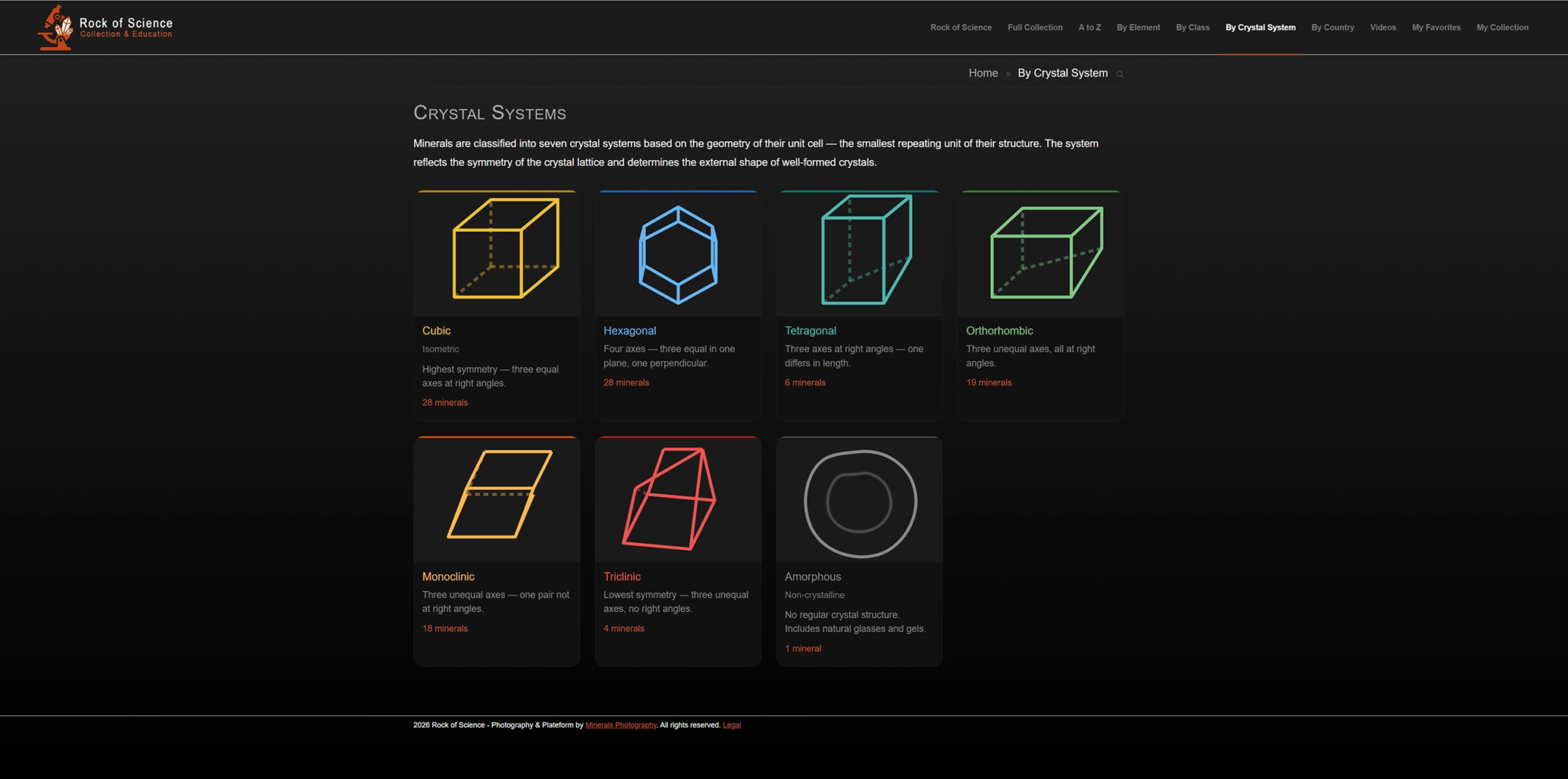
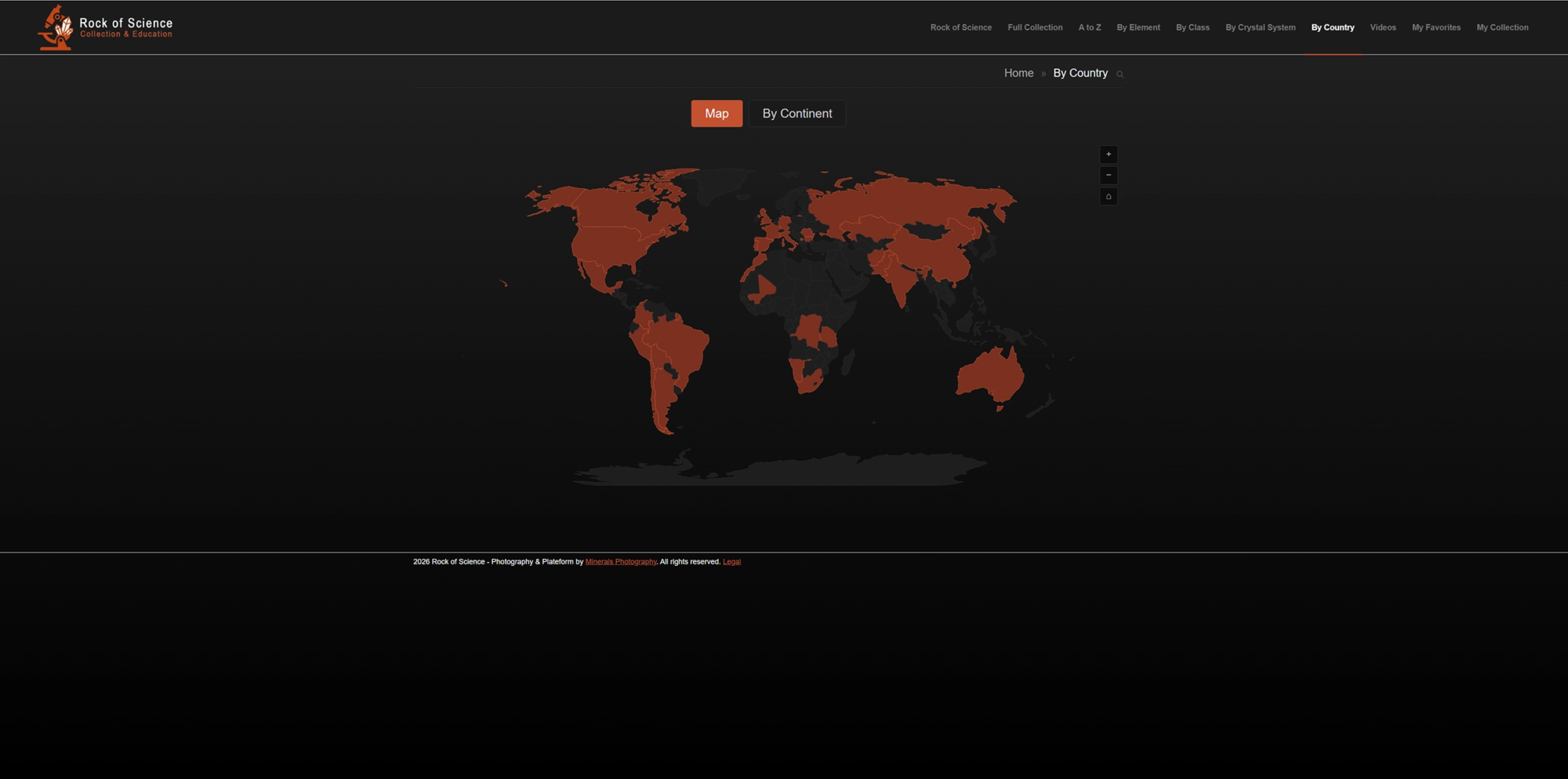
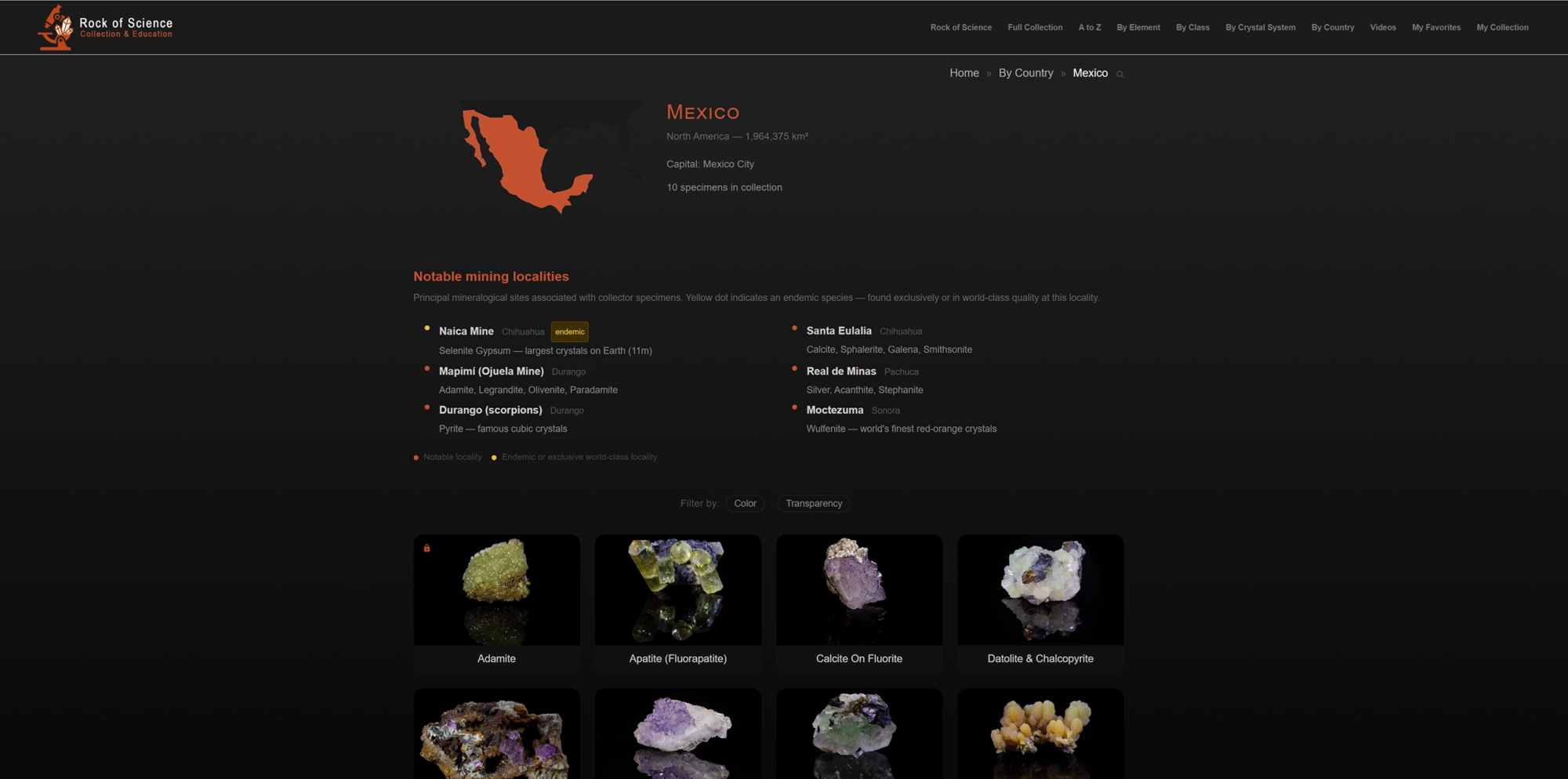
The collection can be browsed in ways that simply did not exist before. An interactive periodic table where only the elements actually present in the collection are active, each one opening to the specimens that contain it. The ten Strunz classes, each with its own page. The seven crystal systems, each illustrated. An interactive world map showing every country represented in the collection, down to the mining localities. An alphabetical index. A view of every filmed specimen. Filters for color, for transparency, for hardness on a sliding Mohs scale. Real-time search.
Each specimen has its own complete page: a photo gallery on one side, the full record on the other. A specimen can hold several minerals, each with its formula, its elements, its family, its hardness shown on a visual scale from talc to diamond, with the kind of plain explanation that means something, scratches glass, marked by a fingernail. Every element, every family, every country is a link. The related specimens a visitor sees are never random: they follow the path that visitor took to arrive.
And there is a private layer the visitor never sees. The owner, logged in, sees the same collection with everything a collector actually needs to manage it: purchase price, estimated value, provenance, storage location, acquisition history, each value in its own currency. Conservation alerts that fire automatically for the species known to be sensitive to light, humidity, or handling. A valued inventory of the entire collection, generated as a single document, ready to keep or hand to an insurer. Printable QR labels for the display cabinet, where a phone held to the label opens the specimen’s full page.

Where it stands now
rock-of-science.org is a real collection, the one that started this whole story in 2021, now grown into something its first version could never have supported. It is also the proof of what the platform can do.
The people at Chamonix asked me to reach out when it was ready. It is ready. And it is no longer for one collector. It is for any collector whose collection has outgrown whatever holds it now, whose current setup is about as light and easy to move as an anvil welded to the floor.
That is what Rock of Science is. It began as a favor for a friend. It became something I am genuinely proud of.
 © Minerals Photography — Camarda Visual Studio LLC
 © Camarda Visual Studio LLC — Minerals Photography — All rights reserved